When the Antient and Modern Grand Lodges came together to form the United Grand Lodge of England (UGLE) in 1813 they declared that ‘Pure Antient Masonry’ consists of three degrees-the Entered Apprentice, the Fellow Craft, and the Master Mason including the Royal Arch.
This declaration still stands at the front of our Book of Constitutions and means there are four parts to a Freemason’s journey. For historical reasons, the first three are governed by UGLE, while the Royal Arch is governed by the Supreme Grand Chapter of England-but in real terms it’s one organisation.
The journey through Pure Antient Masonry and the discoveries each person makes in the Royal Arch are very personal. But you will discover that, even today, these allegories still represent valuable lessons we can all learn from - and enjoy in the process.
How to join
The prime qualification for admission into the Royal Arch is to be a Master Mason, of at least four weeks standing, in a Lodge under the United Grand Lodge of England, or a Lodge under a Grand Lodge recognised by it.
Email enquiries@durhamfreemasons.org or speak to your Lodge Royal Arch representative.

Having landed on this page, you are probably wondering ‘Should I join the Royal Arch and if so what’s in it for me?’
The short answer to whether you should join is an emphatic YES.
Why? Because it is your fourth stage in the Craft and makes your Journey through Craft Masonry whole. After all, you wouldn’t watch a four-part box set and then miss final episode, would you? So is the case with the Royal Arch.
But what’s in it for me? Well, you qualify for membership earlier than you might think and you don't have to be a Past Master to join; in fact, you can join the Royal Arch four weeks after you have been raised in the Third Degree.
Its ceremony is different but also familiar and because it is supported by several Lodges you get the chance to meet, talk and network with many more Masons in your area. The ceremony is colourful and full of symbolism as one would expect, and as always, you’ll find the Companions friendly, hospitable, and caring, thus increasing your enjoyment of Masonry in general.
You also of course get to wear your Royal Arch jewel in your Craft Lodge which is a demonstration of your pride in membership of the Royal Arch to your fellow brethren, something that other orders are not able to do, and an expression to others that you have completed your journey through Pure Antient Freemasonry.
To find out more please view our leaflet ‘An Invitation to Join the Royal Arch’ and the ‘Discover More’ booklet on this page.
What is ARCHWAY?
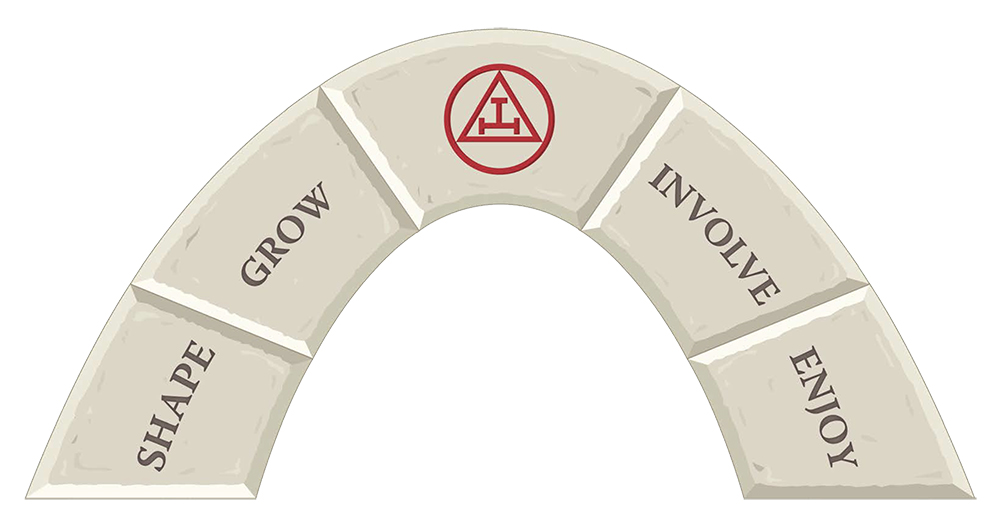
Archway is designed for Royal Arch Chapters to help shape their future, grow their membership and enhance their member’s experience. It is based on extensive research of what our members want-and what works well in successful, thriving Chapters across our Constitution. Many of the challenges that Chapters face are different to Lodges. Archway is therefore not a simple translation of the Members’ Pathway into the Royal Arch, and so has been developed separately. However, some of the challenges are similar. References to resources within the Members’ Pathway and Solomon are therefore provided where relevant. Archway aims to help Chapters become more vibrant and more enjoyable, so that every Companion looks forward to their next meeting with enthusiasm. Resources to enhance understanding of the Royal Arch are also provided along with advice for attracting new members, and for supporting every member of the Chapter.
It is intended to be an evolving resource with more examples and case studies of good practice added over time. There is no one size fits all solution, but the resources and options it offers highlight what is possible to achieve if Chapters wish to embrace change and secure their future. We encourage you to head to Archway and try for yourself.

The history of the Royal Arch
The Premier Grand Lodge was formed in London in 1717. Prior to that time only two degrees were practised in England - the Entered Apprentice and Fellow Craft. Thereafter a third - the Hiramic degree - began to be worked in Lodges to distinguish Master Masons from Fellow Crafts.
However, the third degree is disappointing and anti-climactic in that the genuine secrets are lost, and it was inevitable that a further ceremony would be introduced to rectify this deficiency. While the third degree deals with the building of the first Temple at Jerusalem by King Solomon, it was a logical step that the events surrounding its rebuilding, after the return of the Jews from their exile in Babylon, should be adopted to form the background for the rediscovery of the lost secrets. This story gradually developed into the Royal Arch. At first, this additional ceremony was used to distinguish men, who had presided as Master of their Lodge. However, with time this requirement was eased and reduced to “…having passed the chair” and resulted in the Royal Arch becoming increasingly popular in the 1750’s.
In 1756 a group claiming to adhere to the ancient principles of the Craft broke away from the Premier Grand Lodge and formed what became known as the Grand Lodge of the Antients. Consequently, the original Grand Lodge was paradoxically labelled as the Moderns. There were many reasons for this schism, but over time the focus became their disagreements over the status of the Royal Arch. In essence, the Antients were enthusiastic supporters of Royal Arch Masonry, which they worked as a fourth degree in their Craft Lodges. The Moderns took the opposite line and officially refused to acknowledge it. However, they had no objection to Brethren joining it as a separately organised Society, which many of their senior members duly did.
On 22nd July 1766 the Grand Master of the Moderns, Lord Blayney, concerned that many of his Lodges were following the lead of the Antients and working this “fourth” degree under the authority of their Craft warrants, decided to regularise the situation by setting up a Body with authority to regulate the Royal Arch. He entered into a Charter of Compact, which laid down that: “None but discreet and experienced Master Masons shall receive exaltation to this sublime Degree”. A Grand Chapter was constituted and called the Grand and Royal Chapter of the Royal Arch of Jerusalem, from which the current Supreme Grand Chapter of England is directly descended. One of the other signatories to this document was Thomas Dunckerley, who later served as Grand Superintendent of Hampshire from 1778 until 1795 and of the then separate Province of Isle of Wight from 1778 until 1795. In time, Royal Arch ceremonies were progressively worked in separate Chapters and “Masters” became known as “Principals”.
Happily, in 1813 the Antients and Moderns were able to reconcile their differences and join together, under MW Bro HRH the Duke of Sussex as Grand Master, to form what we now know as the United Grand Lodge of England. In its Book of Constitutions, a copy of which is presented to every Brother on his Initiation, the General Laws and Regulations for the Government of the Craft have since 1853 been preceded by the following Preliminary Declaration:-
“By the solemn Act of Union between the two Grand Lodges of Freemasons of England in December 1813, it was declared and pronounced that pure Antient Masonry consists of three degrees and no more, viz. those of the Entered Apprentice, the Fellow Craft, and the Master Mason, including the Supreme Order of the Holy Royal Arch”.
This statement was in essence the compromise that enabled the unification to take place. Over time the Royal Arch has come to be seen as an essential and natural progression after the Craft and the integral final step in Pure Antient Freemasonry.
The exaltation ceremony story
The Royal Arch exaltation ceremony story takes place some 500 years after the dedication of Solomon’s Temple. King Solomon has long since died. Jerusalem has since been attacked by the Babylonians, the city and its once magnificent temple have been destroyed and its inhabitants taken into captivity into Babylon, where they have remained for 70 years.
We have arrived at that period in history where the Babylonian Empire itself has been attacked and defeated by Cyrus the King of Persia. Cyrus has recently issued a decree allowing the descendants of the Hebrew exiles to return to their native land.
At the start of your exaltation, you will enter the Chapter blindfolded and represent one of those exiles returning to Jerusalem seeking to participate in the light of our mysteries with his colleagues as Sojourners, or Journeyman builders.
The Chapter room and the carpet represent a building site in the ruined city, where Solomon’s temple formerly stood. You will symbolically traverse across the ruins to arrive at the crown of a vaulted chamber, where the first change in the scene occurs.
The carpet and equipment on the floor of the Chapter now represent an underground vaulted chamber and its contents, and amongst those contents you will make a most important discovery!
